
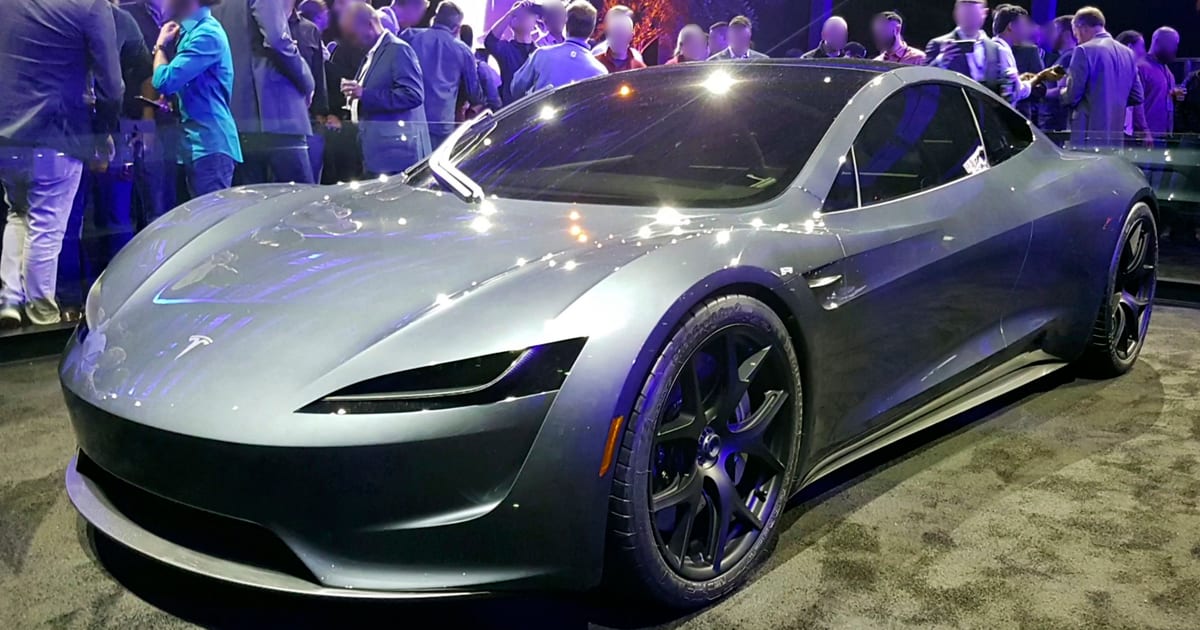
Live event
Tesla Roadster unveiling
Thu, Oct 15 · time to be confirmed
Watch it with us: live updates, the stream and what it all means.
Tesla has pushed its next-generation Roadster demonstration back two weeks, from October 1 to October 15, saying severe weather in central Texas made an outdoor event unsafe. The delay lands on a small, patient group of customers who paid $50,000 deposits, or $250,000 for a limited launch edition, on a car Tesla first showed in November 2017.
The new date matters less than what it shows. October 15 is the fifth demo date Tesla has set this year, for a car it once said would be in production in 2020. And because Tesla says the event can't be moved indoors, the new date depends on the forecast as much as the old one did.
So the real question isn't whether a Roadster shows up near Waco in two weeks. It's whether this demo finally starts a production clock that has been reset again and again since the 2017 unveiling.
How did a 2020 car end up with five demo dates in 2026?
The Roadster's record is the strongest reason for caution, and every step of it is on the record.
Tesla unveiled the second-generation Roadster in November 2017 and said it would go into production in 2020. That year came and went without a car. Six years later, Tesla still has no production model, only a demonstration date.
The slippage has sped up rather than slowed. This year alone, the demo was set for April 1, then late April, then August, then October 1, and now October 15. That's five dates in roughly six months.
Elon Musk saw some of this coming. He once joked that holding the event on April Fools' Day would give him "deniability" if it slipped. It did.
The production target has moved along with the demo. Tesla now points to "2027 or 2028", and TechCrunch reports that production is expected to begin at least a year after the reveal.
The arithmetic is simple. If the demo happens on October 15, 2026, a year later puts the earliest production start in late 2027. That fits Tesla's "2027 or 2028" guidance, but only if the reveal itself doesn't move again.
Keep that in mind for every date in this story. From the demo to the factory line, these are company targets, and the 2020 target already went unmet.
Why does the weather get to decide the date?
Most car launches happen on a stage, under lights, with the car rolling a few feet. This one, at least as reported, is built around something much harder to control.
The event is reportedly set for SpaceX's rocket test site in McGregor, Texas, just outside Waco. Electrek reports that Tesla plans to lift the Roadster off the ground with cold gas thrusters built by SpaceX, with nobody inside the car and spectators kept several hundred yards away. Those thrusters work by pushing pressurized gas out of a nozzle, so the car would be riding on jets of gas rather than burning fuel.
Tesla hasn't publicly confirmed the hover plan. But the reported setup matches what the company has said in public: an outdoor-only event, a date that depends on the weather, and a decision made after talking with local forecasters.
Invited guests were warned. Before the postponement, Tesla emailed them to say the event had to be held outdoors and that bad weather could force a new date. So the delay itself didn't come out of nowhere.
What Tesla hasn't shared is just as telling. As of the postponement, it hadn't announced a start time, confirmed a venue or described the format. Reservation holders and anyone hoping to attend are planning around a date with very little attached to it.
An empty car and a crowd held several hundred yards back is how you'd plan a stunt with a thin margin for error. That's also why the plan is so exposed to wind.
Is the wind the whole story?
Tesla's explanation is short. The company said it consulted local forecasters before making the call and that the event couldn't be moved inside. Musk's version was shorter still: he blamed the two-week slip on strong wind.
The forecast for October 1 supports at least the first part of that. It showed rain odds above 80%, a chance of storms and gusts in the low 30s mph. Few people would argue with calling off an outdoor performance demo in those conditions.
The doubt is about the length of the delay, not the delay itself. Electrek noted that the forecast improved within days, showing mostly dry weather and gusts around 13 mph for October 5 through 7. That's well under half the wind expected for the original date.
If a calmer window opened within a week, why wait a full fourteen days? Tesla hasn't said. Electrek raised the possibility that the demo itself is running into technical trouble.
Teslarati reads the same facts differently. Its argument is that the flying part may not be the main issue at all, because wind alone is reason enough to wait for any high-performance demo. Gusts can disrupt acceleration runs and skew top-speed figures, the outlet says.
That point carries weight for a car sold on extreme performance. A demo with numbers inflated or dragged down by the wind would invite exactly the kind of argument Tesla wants to avoid.
Here's where each reading stands:
- Tesla's account: the delay is about weather and safety, and the event has to be outdoors. This is the only official explanation.
- Teslarati's reading: wind is a legitimate reason to wait for any performance demo, with or without a hover.
- Electrek's suspicion: the two-week gap is longer than the weather required, which could point to problems with the demo. That's speculation, not a report of a confirmed fault.
The outside readings aren't mutually exclusive. Wind can be the real trigger for a delay, and an engineering team can still be glad of the extra time. Until Tesla says more, the technical-problem theory is an open question, not a finding.
Who has money riding on the Roadster?
The people with the most at stake are the reservation holders. Tesla took $50,000 deposits on a car priced from about $200,000, and $250,000 reservations for a launch edition capped at 1,000 units.
Some of those buyers have been waiting since the 2017 unveiling. A quarter of a million dollars parked with an automaker for years is a real cost, even for wealthy customers, and each new date pushes back the day they can drive what they paid for.
For Tesla's business, the Roadster barely registers. A $200,000 car with a 1,000-unit launch edition is a halo model, built to draw attention to the brand and show off its engineering, and it won't move the company's sales totals in any meaningful way.
The stock market made that plain the same week. Tesla shares rose 4.65% on Friday to close at $370.59. The move had nothing to do with the Roadster: it followed third-quarter deliveries of 486,532 vehicles, about 25,000 more than Wall Street expected.
That contrast says a lot about where investors' attention sits. Nearly half a million everyday cars delivered in three months mattered far more to the share price than one expensive prototype's reveal date.
A clean demo could still help Tesla's image, especially after a 2020 target that slipped and five demo dates this year. Another slip would mainly test the patience of reservation holders, not the quarterly numbers.
What happens next, and what could knock it off course again?
The weak point in the new plan is the same one that sank the old one. Tesla has made the event outdoor-only and dependent on the weather, so October 15 carries the same risk October 1 did.
If the McGregor forecast turns bad again, Tesla faces the same choice: hold the demo in poor conditions or move it a sixth time. With no indoor fallback, the date is set by the sky as much as by the engineers. That's an awkward spot for a car meant to show off control.
These are the dates and signals to follow:
- Around October 8 to 15: the McGregor forecast. Rain and gusts like those predicted for October 1 would put the new date at risk.
- Before October 15: event details from Tesla. A start time, a confirmed venue and a format are still missing. Confirming or ruling out the hover plan would settle the biggest unknown.
- Later in October: third-quarter earnings. Listen for whether Tesla repeats the "2027 or 2028" production target or changes it.
- October 2027 and beyond: the year-after-reveal clock. If production really starts at least a year after the demo, the reveal date sets the earliest point at which buyers could see cars.
The Roadster was supposed to reach customers in 2020. If it finally lifts off in Texas on the 15th, would that rebuild your trust in Tesla's timelines, or do you need to see a firm delivery date first?
Weather watch: McGregor, Texas
What the forecast says for Thursday, October 15
Sources
- 1.Tesla delays Roadster demo two weeks to October 15, blames weather · Electrek
- 2.Tesla warns weather could delay Roadster demo, and the forecast is ugly · Electrek
- 3.Tesla delays Roadster 2 event again due to bad weather · TechCrunch
- 4.Why Tesla Roadster unveiling delay might have nothing to do with it flying · Teslarati
- 5.Stock Market Today, Oct. 2: Tesla Rises on Q3 Delivery Beat · The Motley Fool
Reported by the WattsUpNext desk from the sources linked below. Spot an error? Tell us at corrections@wattsupnext.com.
The WattsUpNext Brief
Get stories like this in your inbox.
One email each weekday, only the topics you choose. Real news, sourced, no fluff. Unsubscribe in one click.

